

DZCO is a music discovery platform that replaces linear menus with a spatial, mood-driven interface. Instead of scrolling lists, users explore clusters of songs organized around genre, vibe, and context: encouraging curiosity, wandering, and serendipitous listening among users.
Under the guidance of Stephen Zoepf, former professor at Stanford and MIT Alum, I worked as a UX Designer on contract, collaborating closely with my fellow designers and engineering to research user behavior, explore new interaction models, and define early system specifications solving for new user drop off.
DZCO is a music discovery startup replacing traditional linear menus with a spatial, mood-driven interface for music exploration.
As a Product Designer, I led usability testing and research to identify first-time user drop-off points, conducting 22 moderated sessions to uncover friction in onboarding and navigation.
Using these findings, I redesigned key interaction flows and visual systems to reduce cognitive load and improve clarity across the product experience.
This shortened the prototype validation cycle from 4–5 months to approximately 2 weeks, allowing faster iteration, stronger stakeholder alignment, and improved retention by addressing the core barriers preventing new users from understanding the product.
Convincing users to adopt a new music discovery paradigm.
DZCO set out to rethink music discovery through a spatial, map-based experience, but faced a critical adoption challenge. Most users were already deeply embedded in platforms like Spotify and Apple Music, making them hesitant to invest time in learning a novel interface.
The core problem was identifying where friction occurred during onboarding and exploration, and how to reduce uncertainty without diluting DZCO’s differentiated value. The team needed clear insights that could translate into actionable design guidance and technically feasible product direction.

Research-driven simplification of a novel experience.
I conducted exploratory user research and guided usability testing to uncover where users struggled when transitioning from familiar music platforms to DZCO’s map-based model. These insights informed clearer onboarding flows, improved discoverability, and a stronger visual language for social presence within the map.
Working closely with the team, I translated my findings into journey maps, UI specifications, and patent-ready visualizations, helping align product vision with technical feasibility while reducing early adoption friction.
User interviews and usability testing.
To evaluate DZCO’s adoption potential, I conducted interviews that combined idea validation with live usability testing of the MVP.



Age
30
Occupation
Music Journalist
Location
Dallas
A deeply curious music professional who explores music through genres, subgenres, and cultural movements. He values depth, organization, and discovery tools that help him uncover and contextualize new sounds.
I’m always looking for the connective tissue between genres; where sounds come from and where they lead.
Ambivert
Analytical
Focused
Tech fluent
Tech fluent

Age
57
Occupation
History Teacher
Location
Boston
An experienced, reflective traveler who values cultural and historical context. He travels to reconnect with places, music, and memories, and prefers discovery experiences that feel meaningful rather than algorithmic or trend-driven.
Music makes places come alive again. I want to understand where it came from, not just what’s popular.
Introverted
Organized
Analytical
Creative

Age
28
Occupation
Freelance Grapic Designer
Location
NYC
A tech-savvy, urban listener who enjoys discovering new music but feels constrained by traditional playlist-based discovery. She’s curious about new experiences but skeptical of switching unless the value is immediately clear.
I’m always looking for new music, but most apps end up recommending the same things. If I switch, it has to feel genuinely different.
Extrovert
Organized
Creative
Tech fluent
Loyal
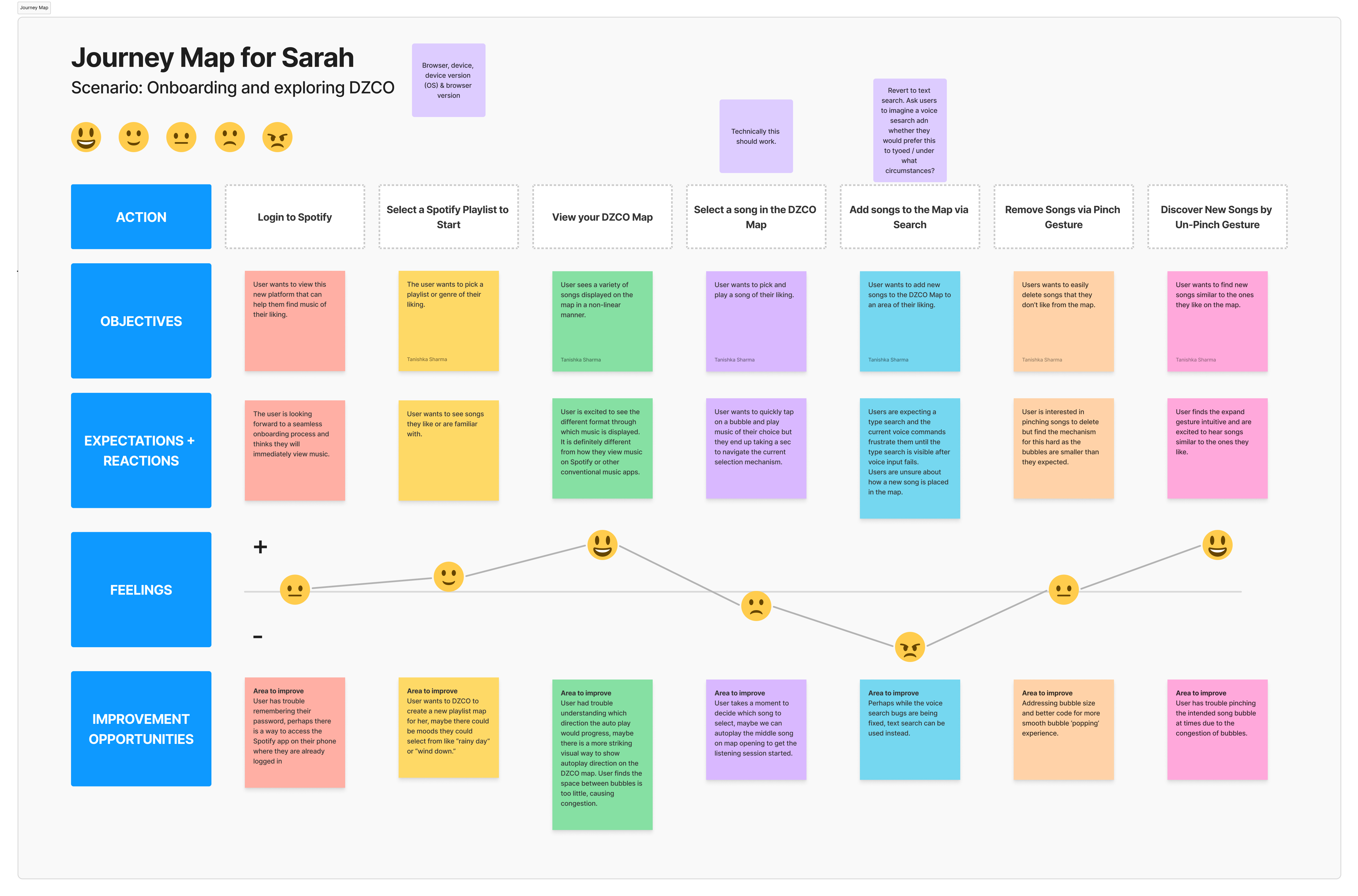
Reducing cognitive load through clearer visual hierarchy.
To address early usability friction, we revised DZCO’s style guide with a clear focus on visual hierarchy and cognitive load reduction. Research showed that users struggled to identify what was interactive, what was secondary, and where to focus first.
Introducing stricter type and color rules made priority states immediately legible. Active elements were elevated through increased size and weight, while secondary content was intentionally de-emphasized. The color palette was simplified to reduce visual competition and avoid unintended brand associations, ensuring that emphasis was driven by interaction state rather than decoration. These changes preserved DZCO’s spatial, exploratory feel while making the interface easier to scan, interpret, and recover within during first-time use.
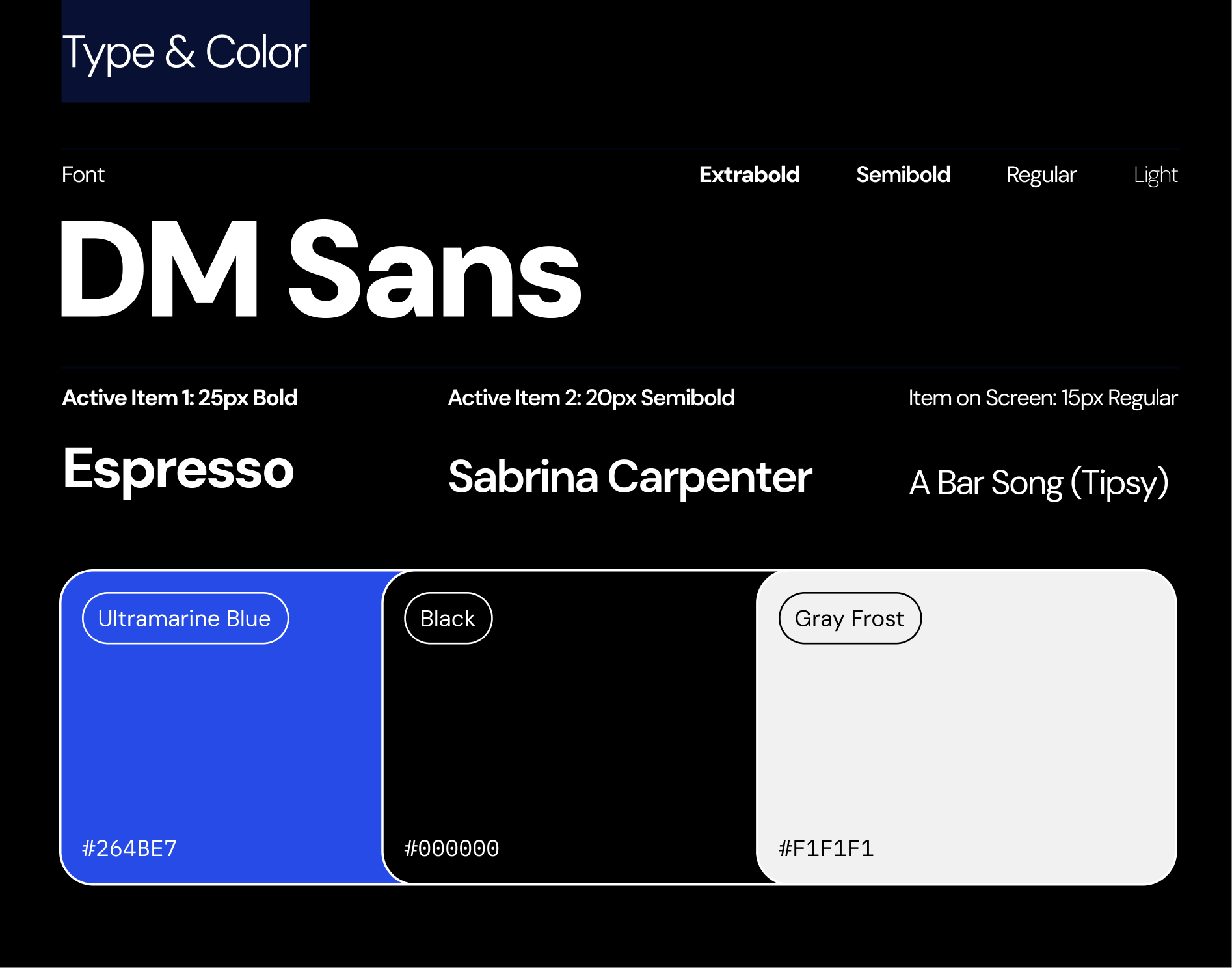
Defining interaction behavior for implementation.
Before moving into execution, key interactions were documented to ensure consistency and technical clarity. Communicating component states, positioning logic, and dynamic behavior to ensure design intent carried through to build.
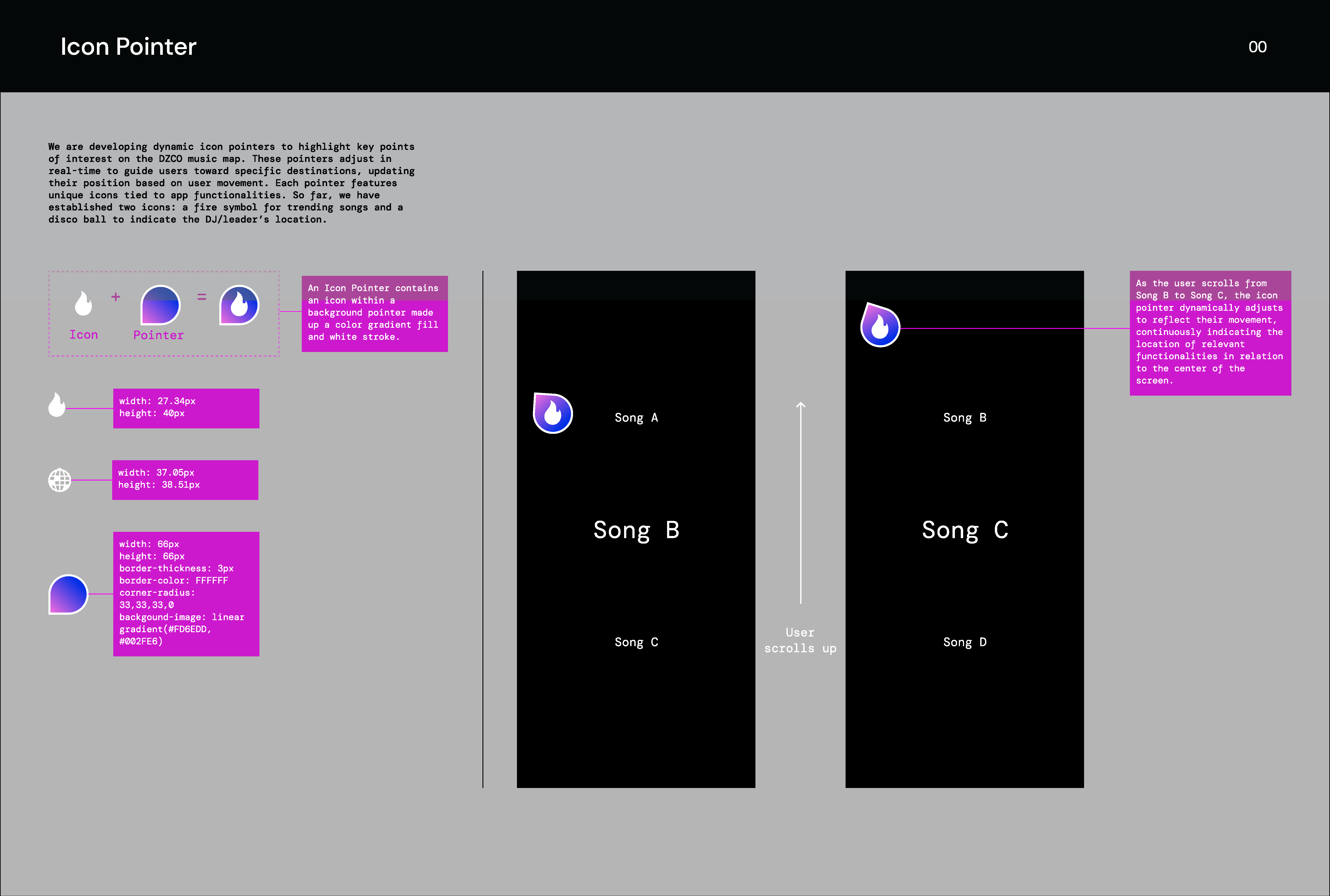
Translating research insights into navigable, confidence-building interfaces.
Guided by research insights around disorientation, cognitive load and limited social connection, we explored design solutions that improved clarity, navigation, and shared discovery, while preserving DZCO’s spatial feel.
Hover over solutions to see designs.
We refined the style guide to reduce visual noise and strengthen hierarchy, creating a clearer and more vibrant foundation for spatial exploration.
We explored a live, map-based social layer that lets users follow friends and see their movement through music in real time, turning discovery into a shared experience.
We introduced gesture-based navigation on the central play control, allowing users to move between songs while preserving the map’s default autoplay behavior.
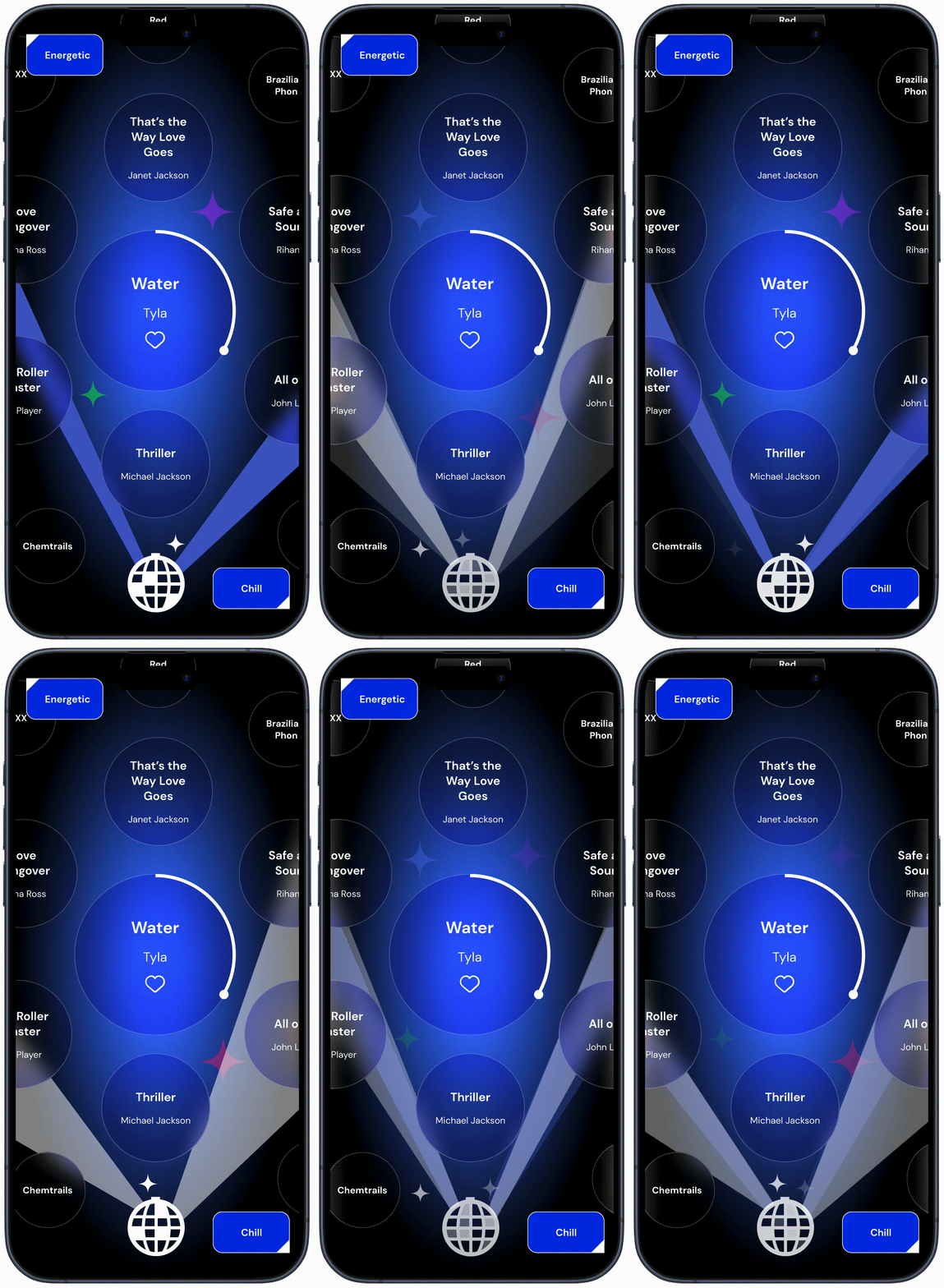
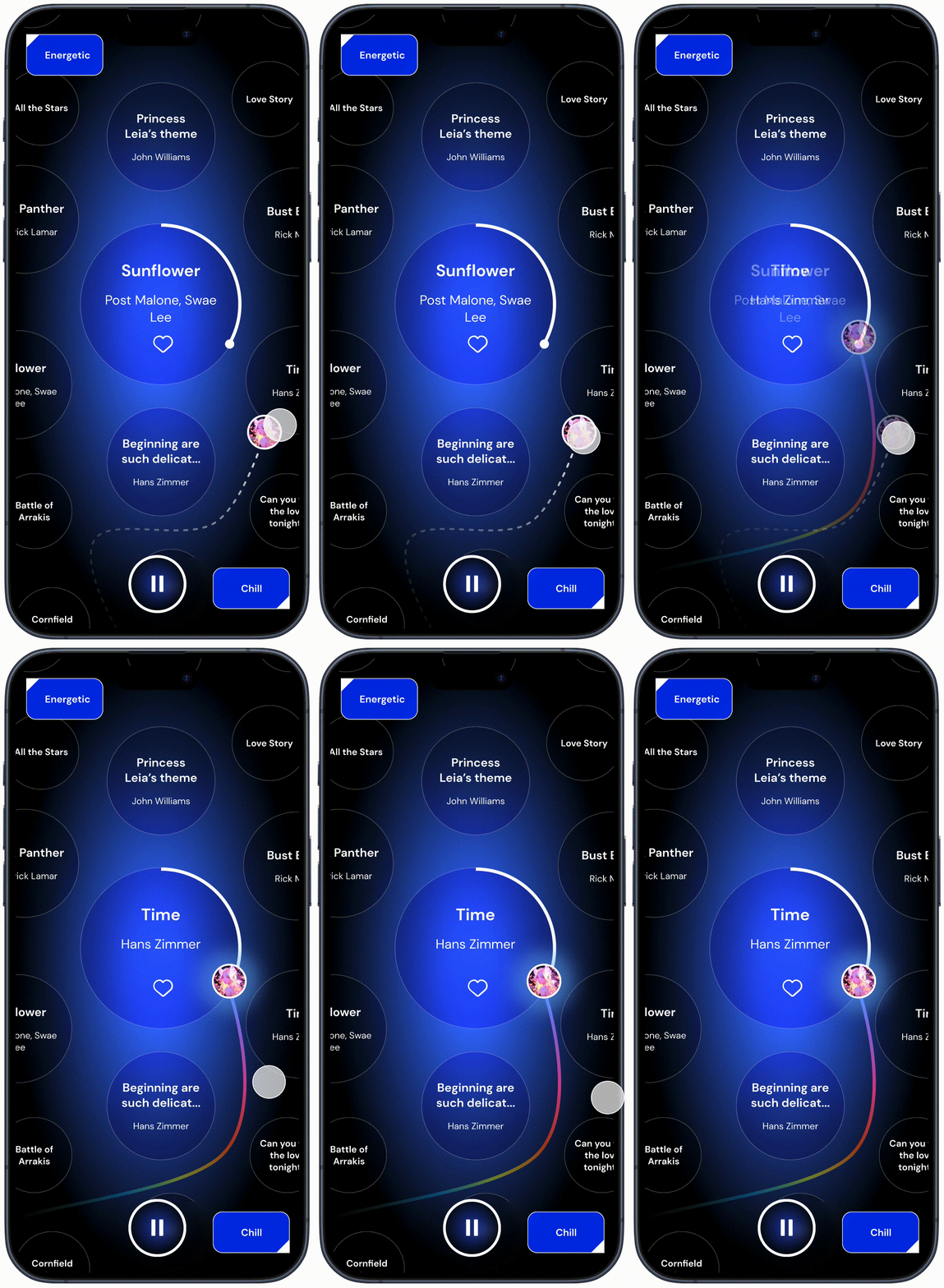
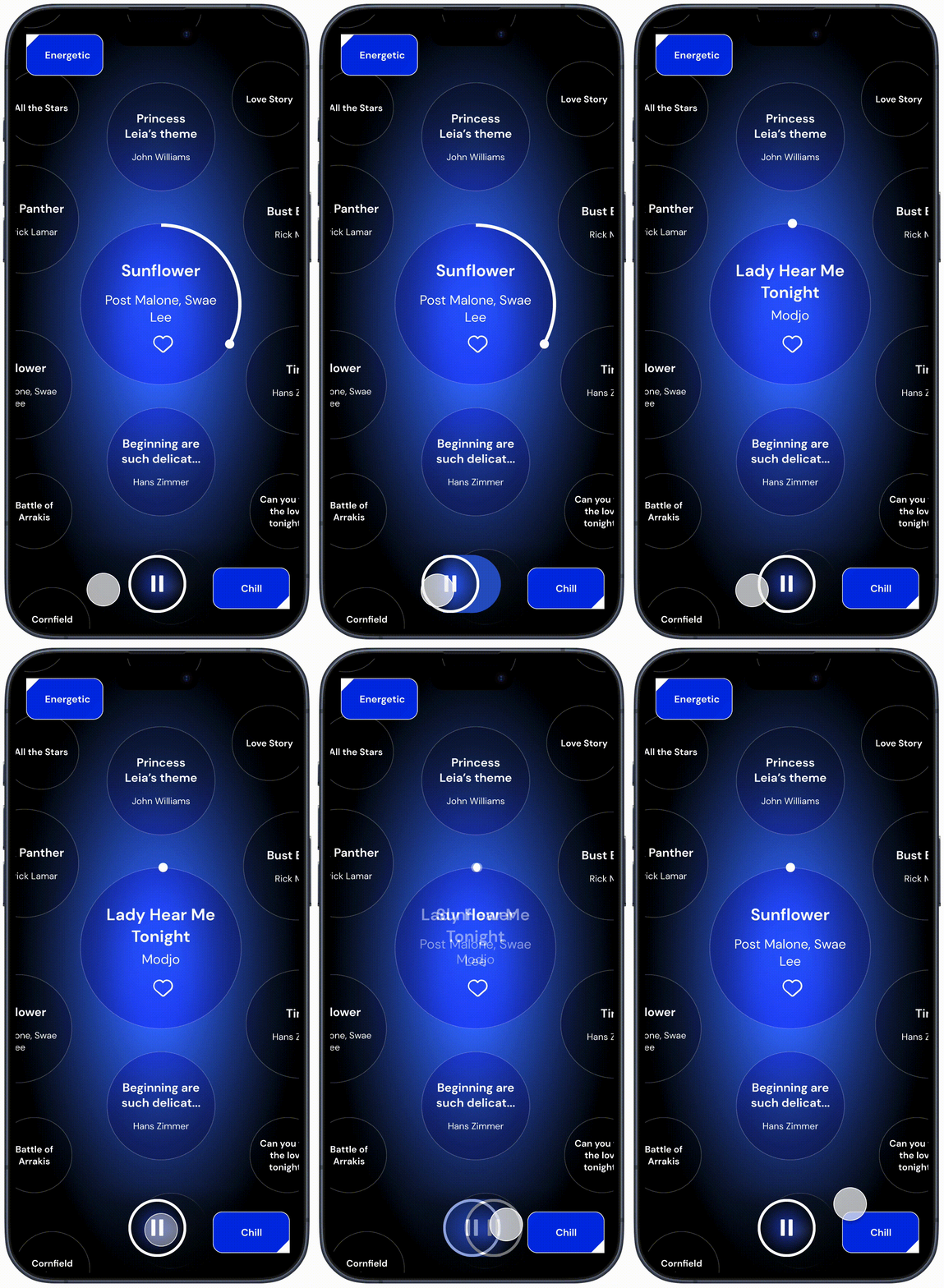

Translating research insights into navigable, confidence-building interfaces.
This project reinforced how fragile first-time experiences are when a product intentionally breaks familiar patterns. While DZCO’s map-based discovery model generated excitement, research showed that novelty alone wasn’t enough. Users needed clearer orientation, stronger cues, and reassurance that exploration wouldn’t lead to confusion.
Designing for DZCO pushed me to balance experimentation with restraint. Preserving the product’s exploratory feel meant introducing just enough hierarchy and affordance to guide users without over-instructing them. Small adjustments to visual hierarchy and interaction cues significantly improved confidence and usability.
Overall, this work clarified how UX extends beyond screens. Contributing across research, interaction design, and system-level decisions taught me how to ground ambitious ideas in practical, user-centered design.
